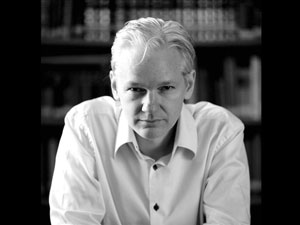
Well, it was a sudden ending to Assange's long and mostly self-imposed incarceration in the UK, but at last he has flown the coop.
His fans will be happy to know that an anonymous donor has paid $500,000 in Bitcoin for his exec jet ride from prison to the Land Down Under. I'm still unclear about who chartered the jet and why the trip would cost so much, but c'est la vie, which is French for "forget it Jake, it's Chinatown."
Once back home Assange was joyously reunited with his lawyer, prison squeeze, and now wife, Stella, and their two little kids.
Frankly, she bothers me.
At age 41 she's spent the last 13 years working for Assange and carrying on a forlorn prison romance. That would be okay in the plot of a Hallmark Channel movie, but with the two kids she'll have to be a lot more hardnosed with Assange now that he's free.
First of all, he does not strike me as the family man type who likes to stay at home at night, will get a steady job and help with the kids. Far from it.
Not to mention that the two rape accusations against him which the Swedish government dropped a few years ago could, possibly, be brought back now that Assange would lack the excuse that he feared extradition to the U.S. if he were to surrender himself to Sweden.
She, on the other hand, does strike me as the 'waiting outside the prison gates' type that is so familiar to correctional institutions the world over. Those romances typically don't survive freedom, or not for very long.
Good luck to you, Mrs. Assange, but I hope you'll have something to fall back on if it turns out that marriage isn't really his bag.
I like this new version of our Julian Assange Update Theme, what with that '60s feel and the heavy-handed anti war visuals. Please enjoy!
As for Assange, you can be sure he's only gotten more pale than ever during the years he's spent in the UK's worst prison. His vitamin D deficiency must be so great by now that he ought to welcome the prospect of doing a stretch in a sunny Colorado Supermax. But no, that lightweight is still fighting extradition.
From Reuters today:
After Monday's hearing, two senior judges said Assange's argument that he might not be able to rely on the U.S. First Amendment right to free speech deserved a full appeal - which is unlikely to be held for months.
-- snip --
Had Monday's ruling gone against him, Assange's team said he could have been on a plane to the U.S. within 24 hours, ending more than 13 years of legal battles in Britain.
It could be many months until the appeal is heard, and then that decision could be taken to the UK Supreme Court.
-- snip --
Assange was first arrested in Britain in 2010 on a Swedish warrant over sex crime allegations that were later dropped.
Since then, he has been variously under house arrest, holed up in Ecuador's embassy in London for seven years and, since 2019, held in the Belmarsh top security jail.
This decision is taken as good news by Team Assange, even though it stretches out his prison time for "many months" on top of the almost 14 years he's already spent in confinement, half of it self-imposed.
Does this guy just like prison? Is he now institutionalized to such an extent that he sees no better way to spend his life than behind bars wearing government underwear?
I assume that he once had higher aspirations. But, that's his business.
If it were me, I'd rather drop all appeals and go face the music in the U.S. legal system. Realistically, he'd be out in a couple years, provided he is even convicted. There is a live possibility that his jury could deadlock and the case would be dropped. If convicted, down the road he could even get a commutation of sentence, as happened to his co-conspirator Bradley Manning.
Either way, in a U.S. prison he could see the (sun)light at the end of the tunnel. I'd pick that.
I've gone up-to-date on our Julian Assange theme song. This Annie Lennox cover version is not quite to my taste musically, but she is easily pale enough to represent the prison-face Assange.
The occasion for this update is the bad news Assange and his supporters received today from the UK High Court:
LONDON, March 26 (Reuters) - WikiLeaks founder Julian Assange's extradition to the United States from Britain was put on hold on Tuesday after London's High Court said the United States must provide assurances he would not face the death penalty.
-- snip --
[His lawyer's objections had been] that Australian-born Assange arguably would not be entitled to rely on the First Amendment right to free speech as a non-U.S. national and, while none of the existing charges carried the death penalty, he could later face a capital offence such as treason, meaning it would be unlawful to extradite him.
-- snip --
The judges invited the U.S. authorities to provide assurances on these matters, saying if they were not forthcoming by April 16, then Assange would be granted permission to appeal.
However, they rejected his lawyers' argument the case was politically motivated or that he would not receive a fair trial.
On balance, it looks like Assange is screwed. Extradition is looming unless the Biden administration wants to throw the case by refusing to provide those mild assurances the High Court asked it for.
Will it? Maybe. I can't imagine what election year calculations are going on in the White House, DOJ, and the Biden campaign.
But one thing I do know. I am thoroughly tired of Assange's self-aggrandizing fantasy about the death penalty. He thrills his supporters with the prospect of the USA sending him to the chair in this or possibly another alternative universe. It's mawkish. Find a better way to build your self-esteem.
Condolences, but Assange isn't charged with any offense that is punishable by death. For that, he'd have to have violated the Prime Directive, or something equally grave.
A High Court judge in London has denied Julian Assange permission to appeal an order to extradite him to the United States, where he faces criminal charges under the Espionage Act.
The decision was dated Tuesday and is the latest in a years-long legal saga. His camp told CNN on Thursday that they will lodge a new appeal next week.
In a ruling dated June 6, 2023 and seen by CNN, Mr. Justice Swift said Assange’s application had been refused stating that “none of the four grounds of appeal raises any properly arguable point.”
After 12 years of more or less self-engineered confinement, first in the Ecuadorean embassy and then in his present lockup, Assange may be, at least in some theoretical sense, fractionally closer to actually being delivered to the U.S. for trial.
Yes, that's our Julian Assange update theme, in honor of the whitest-skinned person to ever come from Australia.
He's in the news today because the UK Home Office has affirmed the U.S. extradition order that was upheld by the UK High Court in December.
Assange has spent the last three years fighting extradition from Belmarsh Prison, where the UK authorities put him due to his habit of skipping bail. Before that he spent seven years in the embassy of Ecuador hiding from Swedish authorities who wanted to investgate him on complaints of rape and sexual assault.
Now, he has 14 days to appeal the Home Office decision, which of course he will. Depending on how that goes, he'll next appeal to a European human rights court.
How much longer can he possibly delay his delivery to American justice? Almost indefinitely, I think. At least, he seems in no hurry to leave his life behind the walls, having spent the last ten of his fifty years in what is basically self-imposed confinement.
Assange is an Australian citizen, improbable as that might seem given his extreme pallor, and he seems to have a supporter in his Foreign Office. As CNN reports:
On Friday, Australia's Foreign Office issued a statement noting the UK decision to extradite Assange, who is an Australian citizen, adding: "We will continue to convey our expectations that Mr Assange is entitled to due process, humane and fair treatment, access to proper medical care, and access to his legal team."
Of course, he can get all that stuff in a U.S. prison. And due process? Assange has gotten exremely undue process, if you ask me. I mean, he's spent ten years fighting a reckoning in a U.S. court that would likely result in a sentence of far less than that. Besides which, he would be able to do that time in an Australian prison thanks to a bilateral agreement.
What the hell, Assange? Would you rather spend the next ten years in Belmarsh than face the music in a U.S. court and get it over with?
That's our Julian Assange update theme, in honor of the whitest-skinned person ever to come from Australia. The first thing he should do once he's sprung is to get a massive dose of vitamin D, if you ask me.
The news today from the UK is that a judge has decided to release Assange rather than extradite him to the U.S., where she fears he might kill himself if confined in a U.S. prison.
In 2018, a British court refused to extradite Lauri Love, a hacker accused of penetrating U.S. government networks, because of the risk he would kill himself. In 2012 then-Home Secretary Theresa May blocked the extradition of Gary McKinnon, who was accused of breaking into U.S. military and space networks, because of the risk he would end his life. So there is a clear pattern here.
On all the substantive issues raised by the U.S. government against Assange, the judge actually agreed. She said that the alleged offenses go beyond "encouraging a journalist." For instance, Assange called for people to join the CIA so they could access confidential information for WikiLeaks, something the judge found to be "beyond investigative journalism."
The judge also said the right to free speech does not give anyone "unfettered discretion" to disclose any document they wish, and she rejected Assange's assertion of free speech laws noting that the difficulty with this argument is it vests in Assange the right to sacrifice the safety of individuals named in leaked documents, in the name of free speech. Such as the 50-some persons who sought asylum in the United States after being so named.
Moreover, the judge pointed out Assange’s eventual "indiscriminate" release of some 800,000 State Department cables, in contrast to his first, more responsible and much smaller, release of cables to news media outlets who published them with redactions.
Warming up to the subject, the judge noted that any hurt caused to Assange's family by his extradition "is nothing unusual in these kind of proceedings." Damn! I am liking this judge.
Regarding the U.S. judicial system, the judge said she does not accept it would be impossible to find twelve impartial jurors, or that the plea bargaining system was unjust, or that U.S. prosecutors would prosecute Assange out of pure vengeance. She even noted that President Trump has publicly praised Assange.
So, then, what's her objection to extradition?
Only that Assange has a frail mental condition. She accepted testimony that Assange suffers from autism and clinical depression, and is at risk of self-harm. If confined in a U.S. prison under special administrative measures, Assange has the intellect and determination to get around suicide prevention measures, she thinks. Therefore, "extradition would be oppressive by reason of Assange’s mental health."
From the AP story:
Assange, who sat quietly in the dock at London’s Central Criminal Court for the ruling, wiped his brow as the decision was announced. His partner Stella Moris, with whom he has two young sons, wept.
Outside court, Moris said the ruling was “the first step towards justice,” but it was not yet time to celebrate.
“I had hoped that today would be the day that Julian would come home,” she said. “Today is not that day, but that day will come soon.”
“Mr. President, tear down these prison walls,” she said. “Let our little boys have their father.”
Ms. Moris is one of Assange’s lawyers and also his jailhouse squeeze, now age 37 with two little kids that he fathered during his years of self-imposed exile in London's Ecuadorian Embassy. Specifically, while in a tent set up inside his room in the embassy in order to avoid the secret cameras that the lovebirds assumed must have been trained on Assange by the CIA.
Ms. Moris says that by 2017 the pair were "secretly engaged,” and that Assange even proposed to her, kind of, via a virtual reality experience.
She is quite sure Assange wants to marry her. Good luck with that, but based on everything I've read about him, Assange does not seem the family-man domestic type.
It is not rare for even more or less normal women to marry convicts. Google “Hybristophilia.”
But Assange is only two weeks away from freedom, unless the USG's appeal of today's decision succeeds, which it probably won't. Like all famous outlaws, he has surely received tons of female fan mail. Once he’s out of his British prison, Assange will have a vastly expanded range of available females. Do you see marriage in that future? I don't.
Whereas, if he were to be extradited, well, the U.S. federal prison system provides many benefits to inmates who wish to marry, including a minimum of four visiting hours per month. (No conjugal visits, however.)
Yes, that's the Julian Assange update theme song, in reference to the lightest-skinned person to ever come out of Australia.
Assange has been squatting in the Ecuadorian embassy in London since 2012 to evade extradition to Sweden in a rape case, charges which reportedly have now been dropped.
Does he really plan to spend the rest of his life in that Ecuadorian embassy? He's been an unhappy - and litigious - guest, so I don't suppose Ecuador would be sorry to see him leave.
The Swedes dropped their case against him after only six or seven years, but I doubt that he can wait out the U.S. government so easily. Meanwhile, he isn't getting any younger. He might as well come out and face the music.
Assange has been staying in the dark for three years now, shut up in Ecuador's London embassy and getting paler by the day while waiting for criminal charges placed against him in Sweden to expire. Three of four charges have now expired but a fourth charge, of rape, remains.
Last week, the London Metropolitan Police announced they are removing their static guards from outside the Ecuadorian embassy. But they aren't letting Assange go ghost. Rather, they say they "will deploy a number of overt and covert tactics to arrest him."
I had no idea that the UK is legally prepared to unilaterally withdraw recognition of a diplomatic premise. Not that I think they will actually do it, at least, not over the minor melodrama that is Julian Assange's Excellent Ecuadorian Embassy Adventure, but I am pleased that they at least raised the possibility.
The UK Foreign Office says it can lift the embassy's diplomatic status to fulfill a "legal obligation" to extradite the 41-year-old.
The law the UK has informed Ecuador it could use in the case is the Diplomatic and Consular Premises Act 1987 [read it here].
It allows the UK to revoke the diplomatic status of an embassy on UK soil, which in this case would potentially allow police to enter the building to arrest Mr Assange for breaching the terms of his bail.
The act was introduced after PC Yvonne Fletcher was shot outside the Libyan Embassy in London in 1984.
You can see a contemporary British TV news report on the murder of 25-year-old Police Constable Fletcher here. All these years later, delivering her killer to justice is still a political football between the UK and the new, improved, Libya.
The idea of a host country revoking the diplomatic recognition of a premise that is being used for un-diplomatic activity appeals to me. Has the U.S. made that kind of legal provision? If not, we should.
The New York Times has some details on Assange's condition inside the Embassy of Ecuador:
The WikiLeaks founder sleeps on an air mattress in a small office that has been converted to a bedroom, according to accounts of those who have visited him. He has access to a computer and continues to oversee WikiLeaks, his lieutenants have said. Reporters outside the building have seen food being delivered from nearby restaurants.
His presence is a challenge for employees of the embassy. One British government official, citing a conversation with a member of the embassy staff, said that the situation was surreal.
A diplomat familiar with Mr. Assange’s situation said that he spent his time in a back room, which gets no direct sunlight. Several weeks ago he had a bad cold and appeared depressed, the source said.
“He can’t get outside to see the sun,” his mother, Christine Assange, said in a recent interview conducted in Quito for BBC Mundo, a BBC Web site. “I’m worried about his health, as I would be for anybody who is having to stay indoors and not get exercise and have sunlight.”
She said some of Mr. Assange’s friends have encouraged him to put on music and dance as a way of getting physical activity and that they had also brought sunlamps.”
I still say Assange looks like David Bowie's Thin White Duke stage persona from the 1970s.
Maybe the sunlamps will help Assange with his vitamin D deficiency and seasonal affective disorder. But I don't think anything can help him with that major case of melanin impoverishment he's got going on. Assange is undoubtedly the lightest-skinned human being ever to come out of Australia. If he gets any paler he might turn translucent and slip right past the British police on watch outside the embassy.
Give him some color with this before he gets away.
Julian Assange is looking very Austin Powers International Man of Mystery-ish in the photo that accompanied the UK Daily Mail's account of his Swedish legal problems. That's quite a Swinging 60s Carnaby Street kind of thing going on with that jacket.
Here's a question for any David Bowie fans out there. Doesn't Julian Assange look a lot like The Thin White Duke, David Bowie's 1976 stage persona? That's what I think of every time I see a photo of Assange.
But that is not what concerns me tonight. Instead, I wonder why Assange is complaining about a government official who leaked something to the press. The leak was about Assange himself, but hey, the man never saw a leak he didn't like before. Why is he violating his principles now?
Assange is not yet in the clear on criminal investigations in Sweden. But, in a bizarre twist, the prosecutor who issued papers for his arrest has herself been reported to the Swedish Prosecution Service by a due-process watchdog group for - of all things - violating Assange's privacy.
The prosecutor who issued the warrant for the arrest of WikiLeaks founder Julian Assange has been reported for violating rules on the confidentiality of preliminary investigations, newspaper Dagens Juridik (DJ) reported on Tuesday.
The prosecutor on duty, Maria Häljebo Kjellstrand, decided on Friday to issue a warrant to arrest Assange on suspicion of rape. She later confirmed to Expressen that there was a case and that Assange was charged in absentia. The warrant was withdrawn one day later.
Due process organisation Rättssäkerhetsorganisationen (RO), which had previously notified the prosecutor through the Ombudsmen of Justice (Justitieombudsmännen, JO) for her conduct in connection with the decision to issue the warrant, has now supplemented its notification, the report said.
According to the organisation, the prosecutor violated the confidentiality of preliminary investigations by giving the media information about this case, DJ reported.
"We believe that the matter has been handled extremely badly for all parties involved and we are highly critical of how quickly one has taken the decision to detain a person," RO Chairman Johan Binninge told DJ.
"From an investigative standpoint, it is a disaster to go out in public this way, which can only harm the investigation. A prosecutor must also take into consideration all parties involved, including the suspect, and consider the consequences of a particular intervention for the suspect, in this case, an internationally known person," he added.
The supplement submitted to Swedish Prosecution Service Authority (Åklagarmyndigheten) information director Karin Rosander confirmed that the warrant decision includes the confidentiality of preliminary investigations. Rosander added that all decisions taken in the matter now be analysed, DJ reported.
Several newspapers, including Svenska Dagbladet, have indicated that the confirmation from the prosecutor had a decisive influence on the editorial decisions that were made.
Assange ought to man-up and ask the Swedes to drop their charges against his own personal leaker. Or at least publicly express support for her, or pay her legals bills, or something. It would be an act of noblesse oblige worthy of The Thin White Duke.