Showing posts with label OBO. Show all posts

Wednesday, June 11, 2025

New OBO Director Comes From 'Bill Clinton, Inc.' What??

The new Director of Overseas Buildings Operations has been announced, and I freely admit that he leaves me perplexed. 

First, he's not a construction guy. No construction experience at all, but lots of bankruptcy and restructuring work. That's quite odd, especially given that a Trump Administration must be full of construction people, or so you’d think. 

But worse is that he comes from a senior position at Teneo, which is the money-grubbing arm of the Clinton Foundation and Bill Clinton’s personal financial benefactor. 

Teneo's website still identifies James Feltman this way:
James (Jim) has more than three decades of experience leading fiduciary and restructuring matters, as well as providing clients with key litigation support and expert witness testimony. As an advisor, Jim has worked primarily on debtor side assignments.
What's up with that? Is Trump putting OBO in receivership? My good friends in OBO didn't do anything to earn that. 

About Teneo, here's a typical news story about its cozy arrangement with the Clintons. Notice that the story comes from NPR and uses Wikileaks stolen email as its sourcing, so it has an impeccable left-side political pedigree despite the content. (So, that means if you dislike the info or the tone, I’ll assume you’re wearing a MAGA hat!)
A newly revealed memo from a former aide to Bill Clinton details substantial overlap between donors to the nonprofit Clinton Foundation and the former president's personal financial activities, a $30 million-plus enterprise described in the memo as "Bill Clinton, Inc."  
Money managers UBS and Barclays, mining giant BHP, and the for-profit educational company Laureate International Universities each made substantial payments to Bill Clinton for speeches or "advisory services," while also contributing to the Clinton Foundation. 
Most of these payments were brokered by Doug Band, who served as a personal aide to Bill Clinton during his White House years, and later as a chief fundraiser for the Clinton Foundation.  
- Snip - 
[Teneo founder] Band's memo also documents the interlocking relationship between the Clinton Foundation's corporate contributors, Teneo clients and Bill Clinton's personal wealth. 
- Snip - 
Band estimated that he'd helped to secure work for the former president that yielded more than $30 million in personal profit between when Clinton left office in 2001 and when the memo was drafted in 2011, with another $66 million in the pipeline at the time.

That is a very strange background for a Trump Admin official. We'll see more from him soon, so we can hope for the best, but prepare for the worse.


Tuesday, September 3, 2024

OBO Remakes Mexico


Or at least, our diplomatic premises there. See the current State Magazine for an article about how my good friends have done a clean sweep of our old and decrepit embassy and consulates there and replaced them with the new stuff. 


Thursday, June 27, 2024

Nice Presentation on New London Embassy, Where Physical Security is Achieved By "Sleight of Hand"


Ah, the Crystal Fortress! 

Was a glass cube on a small site located in a former industrial zone worth a billion dollars? I'd say that it was, at least for those who appreciate architectural understatement in their diplomatic premises. 

Please enjoy this quick program about "how the US built its most hi-tech and controversial embassy," and join me in my high regard for OBO.

Monday, May 13, 2024

Please Give This 'Panic Room' Guy OBO's Address

I have serious reservations about the higher end of the home security market, which it seems to me spirals way out of the bounds of common sense. But, hey, if people - even ones who do not lead drug cartels - will pay big money for secret doors and gimmicks like smoke screen generators, who am I to object if someone supplies that demand? 

The New York Post has a story today about who's buying 'panic rooms'? Despite the subhead, it is, in fact, who you would think.
For not-so-average New Yorkers, there’s Bill Rigdon of Panic Room Builders — who caters to clients with homes worth around $10 million at a minimum.
“The people below that can’t get their head around spending $50,000 for a door,” Rigdon told The Post.
Rigdon builds panic rooms averaging between $100,000 and $200,000 — but can quickly cost well above that. The rooms are equipped with a host of defensive measures and life support such as food, water, plumbing, medical equipment, power sources and communication systems.
Beyond ballistic doors that can stop AK-47 rounds and up, Rigdon’s panic rooms can have electrified handles, smoke-screen launchers, concealed nozzles for blasting dyed pepper spray at intruders and remotely controlled robots or drones armed with shotgun shells.
As with Humble and Vranicar, the names and addresses of Ridgon’s clients are all protected by strict non-disclosure agreements, but he said the city has become “a different ballgame” with “1% of 1% customers” in recent years.
This is where my good friends in OBO come in. They could show this home security guy what the 1% of the 1% of the 1% can afford. We consider $50,000 for a door just getting started

And I hope he comes ready to paint on a big canvas, because we can definitely push the boundaries of common sense. Get us going on a good Fortress Embassy and we'll solve problems that he didn't even know people had in ways that he can't begin to imagine.


Saturday, April 27, 2024

Embassy In a What?


I appreciate the sentiment behind this ill-named bill, but really, there is no 'there' there. 

We'd all like to see new diplomatic presences spring up overnight in all those little Pacific islands. How else could we counter the malign influences of what I like to call the ChiComs? 

But a serious legislative initiative requires some substance, and this bill is all wishful thinking.

From the bill's text:
 
    The Embassy in a Box Act:
Requires the State Department to develop an “embassy in a box concept” that provides expedited procedures and physical resources needed to stand up new diplomatic missions overseas.
Requires the secretary of State to issue guidance so the Department can build new embassies more quickly and save taxpayer dollars.

So then, the bill requires the SecState to figure out what the hell Senator Risch means by an "Embassy in a Box" and then use a magic wand to dispel all the realities of limited resources and even more limited physical infrastructure on those tiny islands that the bill describes as "austere locations."

Apparently, the catchphrase "Embassy in a Box" is supposed to bridge the gap between our wish and our reality.  

From my own simple point of view, I'd rather focus on creating a "Box In an Embassy" on the assumption that our staffers may need a safe place to ride out any local Tong Wars. This kind of thing, for example.

Good luck, Senator, but I think this is the kind of bill that doesn't survive contact with reality. 

Tuesday, August 15, 2023

State Owns an Italian Rifle Range? Yes, Soon to Be ConGen Milan

The current issue of State Magazine - in-house publication, but available here to all our valued taxpaying citizens - has a piece on one of State's new consulate design projects, and it's an intriguing one since that new diplomatic premise will be an adaptive reuse of Italy's former national firing range.
"Few cities match Milan’s style, sophistication, and financial clout. A world city on a par with Los Angeles or Mexico City, Greater Milan’s ten million people and its strengths in commerce, design, education, finance, and media make it a leading European Union hub. Milan was the seat of the Western Roman Empire and later ranked among the great cities of the Renaissance. Today, Milan is culture and taste, business and fashion, art and elegance."
Exactly so! Culture and taste, business and fashion, art and elegance, are just what come to my mind when I think of my good friends in the Bureau of Overseas Buildings Operations

Specifically, it is OBO's cultural heritage staff that are taking the lead on this one. Bene per loro!
"OBO’s Office of Cultural Heritage produced a short film about how the United States is building a consulate general in Milan that will integrate classical Italian architecture and American design in a grand act of cultural diplomacy. The film can be seen here."
Please watch the film, and be aware that an unusually intelligent thing is happening here. For once, instead of going straight to the option of building a big ol' forbidding Fortress Embassy, we are using an existing structure that is of importance to our host government and adapting it to our use. That's a win-win for ourself and our host.

Saturday, November 27, 2021

New Embassy Compound Beirut - Why Will it Take a Decade and a Billion $$$ ?


Part of me is thrilled to no end that U.S. Embassy Beirut will, sooner or later, move out of its dinky and haphazard present facilities in East Beirut and into a big, purpose-built, New Embassy Complex. That is an occasion we've been waiting for ever since the previous embassy was destroyed by a suicide truck bomb in 1983, and then the East Beirut embassy annex itself was partially destroyed by a second suicide bomber in 1984. 

1983? 1984? What a long time ago. How many current State Department employees had not yet been born in those years? That replacement embassy has been a long time coming.

Not to spoil my good mood, but what explains the insanely long time between the start of the project and its projected completion date?     


As Diplopundit noted back in 2017, the project broke ground in April 2017, after a construction contract was awarded in December 2016, with completion anticipated in 2022. The design phase of the project was initiated in 2013 when a contract was awarded to Morphosis Architects

Morphosis? The same firm that designed the roundly hated Federal building in San Francisco? The building that has been called a green nightmare? The building that came in dead last in a GSA survey of employee post-occupancy satisfaction? Yes, the same. 

I know nothing from architecture, but I can easily understand all the hate for a 15-story office building in which the elevators stop only at every third floor, where the employees can't have window shades to cut down on sun glare, where there is no heating or air conditioning (except in the manager's offices!), where there is no on-site cafe or restaurant for its 2,400 employees but there is a public plaza that attracted so much crime, trash, and drug use that it is now getting a big forbidding perimeter fence

To be fair, Morphosis' San Francisco design has also gotten some awards, however, none of them came from the poor wretches who have to work there. 

But enough said of the new embassy's architecture. I'm far more concerned about the project schedule.

Judging entirely from the embassy and Overseas Buildings Operations (OBO) press releases, it appears the plan was to spend five long years in the design phase - 2013 to 2017 - followed by another five long years in the construction phase. Project delays have now pushed the anticipated completion date out yet another year into 2023. But understand this: OBO intended to spend an entire decade to get that new embassy completed.

That is outrageous. I mean no offense to my good friends in OBO - and they really are my friends, I mean that sincerely - but WHAT WERE YOU THINKING when you approved a plan to build a new embassy in Beirut that would take an entire decade to complete? I'll put aside the matter of the 1+ billion dollar cost. Whatever happened to the sense of urgency that was the entire reason for the Capital Security Construction Program? 

A plain utilitarian office and residential compound that took half as long to complete as one of Morphosis' eccentric masterpieces would have been a far better choice.

Embassy Beirut employees have been living and working in a ramshackle collection of buildings on a hastily-secured compound for 37 years and counting. Granted the security environment in Lebanon is not so acute now as it once was, but still, Hizbollah has pretty much free run of the place so speed really ought to have been a much higher priority for OBO than whatever design excellence whim-wham it is that Morphosis is bringing so very slowly.

Monday, September 27, 2021

Sad Outcome For a Former OBO Employee

It has happened before, but one does not get used to seeing the news that a colleague you've known for many years, even one you haven't worked with regularly, has pled guilty to a crime.

See the details behind the guilty plea at Diplopundit's post, here. The bottom line is that $60,000, which DOJ's press release described as "lucrative kickbacks," went from an OBO construction contractor to an OBO employee in exchange for insider information that gave the contractor an advantage in winning contract awards.

The guilty party in this case is someone I like and have high regard for. Her motive was financial desperation, apparently. Considered on a scale of culpability, her offense ought to be seen as somewhat less than that of the contractor who purposefully cultivated her as his inside source.

Now, as for the real villain in the piece, OBO's construction contractor Montage Inc and its CEO, I have always had as low an opinion as one could have, right from the start of its engagement with OBO and many other government clients. There was just an auru of sleeze around whatever I saw of the company.

Good riddence to that guy.

Friday, June 25, 2021

Fortress Embassy Niamey Has a Weird Facade


My good friends in the Bureau of Overseas Buildings Operations (OBO) just cut the ribbon on yet another new Fortress Embassy, this one in Niamey, which, I can tell you, really, really, needed one. See the details here: Dedicates the New U.S. Embassy in Niamey, Niger.

I have one question about the design. That rust-colored thing that covers all of the exterior windows and extends a bit above the roof, what is that? Probably a sun screen, I'm guessing, which makes sense for that climate.  

But doesn't it look exactly like the new southern border fence? 

The first section of completed new border fence 


Not that I mind an artistic reference to the border fence, you understand. However, I'm surprised that feature passed through so many architectural hands, from OBO itself to its construction contractor and their design firm, without someone objecting. 


Thursday, May 6, 2021

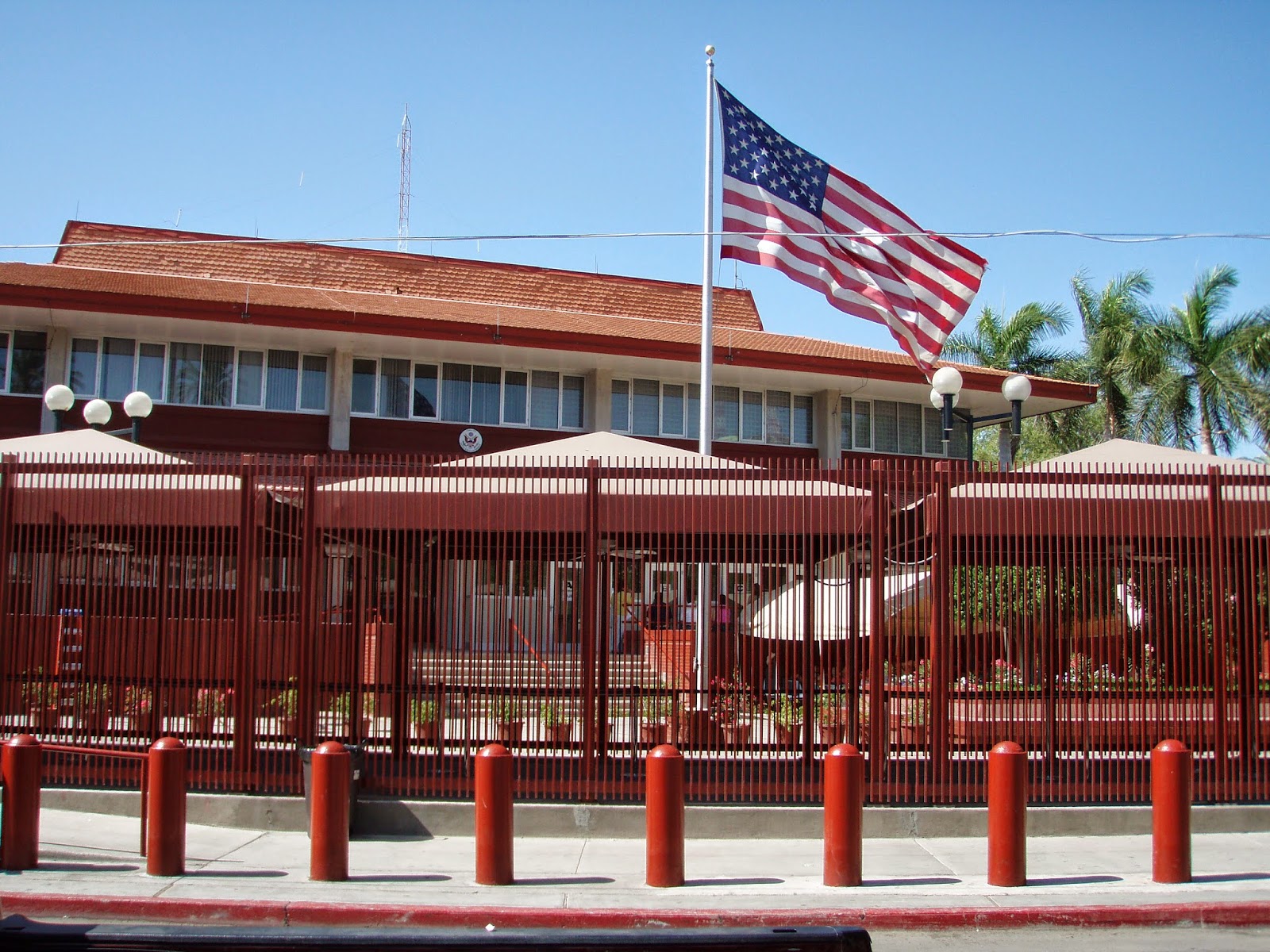
New Consulate Office Building in Hermosillo, Mexico, Topped Out


Sweet deal for CG Hermosillo, which gets to move out of the quirky building it has occupied since the early 1980s, the one that kind of resembles a Pizza Hut only with a pagoda roof. You can see it in this photo, courtesy of Mexican news media:


The old building was the product of a family-owned construction firm that at one time very nearly monopolized the diplomatic construction business of the USG in Mexico. The patriarch had been a subcontractor on the early 1960s embassy job in Mexico City and his two sons went on to build most of our consulates, including the ones in Tijuana, Guadalajara, Ciudad Juarez, and Monterrey. The family saved design expenses by using the exact same design to build both Juarez and Monterrey, which is commendable.

Hermosillo was the end of the family's streak of good luck, as by then OBO had finally decided it would henceforth take charge of its own business in Mexico. Ever since, OBO has been replacing one old Mexican consulate after another with 'safe, secure, and sustainable' New Consulate Compounds. Plus a New Embassy Compound, too, assuming that project ever gets completed.    

So, NCC Hermosillo marks the end of an era for OBO in Mexico. What's more, the old consulate was the last time OBO ever built a new office building anywhere in the world without taking security standards (boo, security) into account, because in that pre-Inman Commission day there were no standards, at least none that were mandatory.

Enjoy the new building, Hermosillo.
     

Saturday, April 10, 2021

Fortress Embassies to be Fully Funded in the New FY

(CG Guadalajara, according to an OBO design contractor) 


I love the architect's-pastel-watercolor-rendering stage of new embassy construction. The buildings never look half as good in execution as they do in the imagination. It's practically theater of the mind stuff. 

Well, there will be more such happy architectural dreaming this year because the new international affairs budget request has been published and it did not forget my good friends in the Bureau of Overseas Building Operations. They are looking at handling another year of capital security construction projects, i.e., new Fortress Embassies. 

It's on page 29 of the FY21 Congressional Budget Justification:
EMBASSY SECURITY, CONSTRUCTION, AND MAINTENANCE - The Bureau of Overseas Buildings Operations (OBO), funded through the Embassy Security, Construction, and Maintenance (ESCM) appropriation, is responsible for providing U.S. diplomatic and consular missions overseas with secure, safe, and functional facilities that represent the U.S. Government to the host nation and support the Department’s staff in their work to achieve U.S. foreign policy objectives. These facilities represent the best of American planning, design, engineering, construction, and facility management.
The FY 2021 Request is $1.7 billion. The work supported by this request is vital, as more than 93,000 U.S. Government employees from more than 30 agencies at over 291 locations depend on the infrastructure OBO provides and maintains. The FY 2021 Request includes the Department of State’s share of the $2.2 billion Capital Security and Maintenance Cost Sharing Programs to construct and maintain, new, secure facilities, and $100 million to address deferred maintenance for State’s non-cost shared facilities
Which lucky posts will get the next round of safe, secure, and functional new facilities? That is a carefully risk-managed decision, as is explained in this publicly available source of information:
OBO will continue to construct diplomatic facilities based on the Department's list of the most vulnerable facilities and to address other security concerns overseas consistent with available resources. This Vulnerability List, published each year by DS, ranks posts according to their vulnerability across different security threats. The process for identifying and prioritizing projects begins with a review of the Vulnerability List mandated by SECCA. The Vulnerability List is then used to establish the Top 80 list that helps OBO to prioritize facilities that need to reduce security vulnerability. In addition to new construction projects, OBO must also design and construct security upgrades to existing facilities. 
That sounds like a tricky business, but I assume whoever it is in DS who ranks overseas posts according to their vulnerability to security threats must know what he or she is doing.

Sunday, April 5, 2020

Who Will Pay For This Screw-Up in Ashgabat? The 90 to 125 Million Dollar Question

Ashgabat, Turkmenistan, city of white marble and straight lines


This might be the most consequential screw-up in U.S. embassy construction since the Moscow debacle of the 1980s and 1990s. (For a summary of that long-drawn-out disaster, which nearly resulted in embassy construction responsibility being taken out of the hands of the State Department, see the embassy's website.) Anyway, that's the only other one I can recall in which we had to demolish a newly-built embassy.

If it weren’t for the COVID-19 emergency taking up all of Official Washington’s time and attention, we would surely see State getting thrashed by Congress and the White House over an OIG audit report for Ashgabat, Turkmenistan, that came out in February. No one seems to have noticed it yet, which is understandable given the pandemic health crisis. However, the report makes clear that there will be a follow-up, and quite possibly a formal notification to Congress of waste and mismanagement, so I don't see any way that my good friends in OBO will escape repercussions forever.

You can read all about it in Review of Delays Encountered Constructing the New Embassy Compound in Ashgabat, Turkmenistan, a pedestrian title which gives no hint of the political dynamite inside the report.

The report is unclassified and uncontrolled, put out there on the internet for all the public and Congress to see. The OIG certainly isn't hiding it. They even put it in their Twitter feed on February 27. Hey, congressional oversight committees, you're missing a good one here.

The gist of the matter is that since 2016 OBO has been building a new U.S. embassy in Ashgabat, which is a city that imposes two absolute requirements on new buildings: they must have facades of white marble and they must be set back from the street a precise distance, which is referred to as "the red line." Well, we built the main embassy office in the wrong place. And now we will have to demolish it and build it again, this time in the place where the local authorities told us all along it had to go.

From the OIG Report:
[I]n July 2016, the Government of Turkmenistan halted construction of the NOB [New Office Building] because it was being constructed in a location that violated the city’s red line. This error occurred, in part, because OBO personnel failed to follow internal procedures that guide the planning of construction projects … Moreover, they did not require the Architectural and Engineering firm that prepared the project bridging design to deliver required planning documentation that would have alerted OBO about the proper placement of the NOB. In addition, the construction contractor, Caddell, failed to obtain required construction permits from the Turkmen Government prior to initiating construction. As a result, construction of the NOB was halted after approximately $26 million had been expended to construct the facility.

-- Snip --

The operational and financial implications from the improper placement of the NOB are profound. Specifically, because construction of the NOB has not been completed, embassy operations continue to be conducted from multiple locations. According to OBO’s FY 2014 Congressional Notification for constructing the NEC, this arrangement creates security and safety risks. In addition, OBO estimates that it will cost the Department between $90 million and $125 million to rebuild a new NOB in an approved location. This amount is approximately twice what was originally budgeted to construct the NOB.

So many fingers of blame to point at so many parties! And did they say we're going to pay twice the cost that was originally budgeted in order to get this project completed? Yes, well, that will happen when first you construct a building, then you have to tear it down and construct it a second time.

Keeping track, that’s $26 million in sunk costs – construction, design, contractor mobilization, project supervision – to build the wrongly-sited and unpermitted chancery office building, plus between 90 and 125 million in future costs to re-build the chancery on the correct side of the host government’s red line.

For some background on that red line, see The City of White Marble to appreciate how very, very, particular the host country’s government and its President - Protector of the Turkmen! - are about their architecturally eccentric capital city.

Ashgabat may be the strangest city anywhere outside of North Korea. Still, all they asked of us was a white marble chancery building that respected their setback distance from the street so as to keep our new embassy in geometric harmony with every other building in the neighborhood. That’s not so much to ask.

The dramatis personae in this story of – likely – waste and mismanagement include:
  • OBO’s first project manager, now retired, who failed to ensure that the local legal assessment report was properly filed away with OBO headquarters
  • The architectural firm OBO used to prepare the planning documents that guided the eventual design and construction, which failed to press with OBO the issue of the missing local legal assessment
  • The Office of Acquisitions Management and the Office of the Legal Advisor, who must now determine whether a screw-up by the first project manager relieved OBO's construction contractor from its contractual obligations, or whether that contractor is liable for damages
  • The construction contractor, Caddell, who failed to obtain a local building permit, or to verify that one had been obtained, before plunking that new chancery down right on top of the local red line; Caddell is now on the hot seat for paying big damages to OBO, or, just maybe, to boldly charge OBO even more money to compensate for the four years it has been required to suspend work on the chancery ('equitable adjustment for the cost and time impacts'), which I bet would be quite the bargaining chip in a possible settlement negotiation
  • The U.S. Congress, who will eventually wake up to this news, if not now, then in a few more months when they may well get official notice from the OIG that it has found a case of waste and mismanagement

There are also lesser players, like the OBO Director and his headquarters staff, and the Under Secretary for Management. I foresee a judge and jury getting involved, as well.

The current U.S. Ambassador and his predecessor come off pretty well, since the OIG makes clear that they both tried to talk sense to Washington while headquarters officials dithered in the four years since Turkmenistan authorities ordered a halt to construction, refusing to bite the bullet and just demolish that offending chancery.
“By January 2019, the U.S. Ambassador to Turkmenistan informed OBO that he saw no realistic chance the Turkmen Government would allow the building to be completed in its current location, and he advised OBO that the only path forward was to demolish the NOB and rebuild it in accordance with the Turkmen Government’s red line requirement. In June 2019, the newly appointed U.S. Ambassador met with the President of Turkmenistan and again attempted to find a solution other than demolishing and rebuilding the NOB. In response, the Turkmen President reiterated that the red line is Turkmen law and must be upheld.”

But instead of accepting that Turkmen reality, OBO tried to wriggle off the hook. It proposed adding a massive fig leaf – an earthen berm – to make the chancery’s red line intrusion harder for passersby to see, but the local authorities didn’t go for that. It explored a partial demolition of the unfinished chancery, but that was not a viable option. It even asked the locals if they would be open to a cost-sharing arrangement to pay for the full demolition and reconstruction of the chancery, but no such luck.

To me, that dithering and wishful thinking is the greatest fault in this sad story. It should not have taken four years to face the facts and understand there is no way out of this dilemma other than knocking down that partially-finished chancery. The sooner you do it, the faster this will be over and the fewest dollars will have been wasted.

Now, having dragged the problem out for four years, not only does OBO still have to rebuild the chancery, but State has a major legal problem and financial exposure on its hands if it tries to fix responsibility on its construction contractor, Caddell. After all, it was Caddell that failed to obtain a construction permit for the new embassy, which is a huge oversight, to say the least. So doesn't Caddell own this 90 to 125 million dollar problem? Maybe. But what equitable adjustment does OBO owe Caddell for the four years since it ordered Caddell to stop work on the biggest part of its Ashgabat contract? The answers will depend on how a judge sees contractual orders of precedence and other matters of procurement law.

Finally, let’s not forget the staff of the U.S. Mission in Turkmenistan, who will continue to have their operations split between multiple locations, some of them highly deficient in both security and safety (in particular, seismic safety) for years to come.

More to come on this, for sure.

Saturday, November 3, 2018

Picking Up the Pace of New Embassy Construction


The U.S. Government Accountability Office recently published a report criticizing my good friends in the Bureau of Overseas Buildings Operations for failing to maintain the rapid pace they had previously set in the Capital Security Construction Program, that long-term program for replacing our most vulnerable overseas diplomatic facilities with 'safe, secure, and modern' new buildings.

You can read the GAO report at a publicly available source of information here: Embassy Construction: Pace Is Slower Than Projected, and State Could Make Program Improvements. A couple excerpts will provide the background for that long-term new embassy building program:
Following the bombings in Africa, the Secure Embassy Construction and Counterterrorism Act of 1999 required State to develop and report a list of diplomatic facilities scheduled for replacement based on their vulnerability to terrorist attack. One of the congressional findings in the Secure Embassy Construction and Counterterrorism Act of 1999 was that unless embassy vulnerabilities are addressed in a sustained and financially realistic manner, the lives and safety of U.S. employees in diplomatic facilities will continue to be at risk from further terrorist attacks. State subsequently initiated the CSCP [Capital Security Construction Program] to construct new embassies. The CSCP is administered by OBO. [Page 10]

In general, according to OBO policy, the CSCP is guided by Diplomatic Security’s annual Security Environment Threat List of security rankings for posts, from which OBO develops a “Top 80” list of the 80 most at-risk posts needing a new embassy. OBO uses the Top 80 list to develop and adjust the CSCP schedule, which presents planned embassy awards for the current fiscal year and for each of the next 5 fiscal years. [Page 26]

Well, I'm not sure I share the GAO's concern about the slowing pace of new construction starts, because this past week - which, as you government-employed people, know is the start of a new Fiscal Year - OBO signed a bundle of new design or construction contracts. Here are the press releases:
The Department of State announces the selection of Skidmore, Owings, and Merrill of San Francisco, California as the design architect for the new U.S. Embassy complex in Windhoek, Namibia ... The multi-building complex will be situated on a site in the Klein Windhoek neighborhood and will provide a safe, secure, and modern facility platform for the Embassy community and those it serves.

The Department of State has awarded the construction contract for the new U.S. Embassy in New Delhi, India to B.L. Harbert International of Birmingham, Alabama ... This complex will provide a safe, secure, and modern facility platform for the Embassy community and those it serves. Weiss/Manfredi Architects of New York, New York is the architect for the project.

The Department of State has awarded the construction contract for the new U.S. Embassy in Tegucigalpa, Honduras to B.L. Harbert International of Birmingham, Alabama ... This complex will provide a safe, secure, and modern facility platform for the Embassy community and those it serves. SHoP Architects of New York, New York is the architect for the project.

The Department of State announces the selection of Miller Hull Partnership of Seattle, Washington as the design architect for the new U.S. Consulate General project in Merida, Mexico ... The multi-building complex will be situated on an approximately seven acre site in the Via Montejo development and will provide a safe, secure, and modern facility platform for the Consulate community and those it serves.

The Department of State has awarded the construction contract for the new U.S. Consulate General project in Guadalajara, Mexico to B.L. Harbert International of Birmingham, Alabama ... This complex will provide a safe, secure, and modern facility platform for the Consulate community and those it serves. Miller Hull Partnership, LLP of Seattle, Washington is the design architect for the project and Page of Washington, D.C. is the architect of record.

The Department of State has awarded the construction contract for the new U.S. Consulate General project in Hermosillo, Mexico to B.L. Harbert International of Birmingham, Alabama ... This complex will provide a safe, secure, and modern facility platform for the Consulate community and those it serves. Richard + Bauer of Phoenix, Arizona is the design architect for the project and Page of Washington, D.C. is the architect of record.

That's six new embassies and consulates now under contract, which is not too shabby. Also, it creates six new slots on that Top 80 list of most at-risk posts for consideration in next year's prioritized contract awards. And for the year after that, and so on, for as long as Congress keeps the Capital Security Construction Program money coming.

Friday, September 21, 2018

The Hatch Act Still Applies After 5:31 PM


You're probably seen the video of a Department of State employee explaining how he cleverly skirts the Hatch Act prohibition on doing partisan political activities in his government workplace. He simply keeps his political work in draft until after office hours. Then “as soon as 5:31 hits" he sends it out. That will work, right?

No, it turns out it won't. If Mister Karaffa had read the Office of Ethics and Financial Disclosure's rules on prohibited political activities he would have learned that a domestically-assigned Civil Service employee such as himself may not engage in any political activity, even while off duty, while he is in a government office or building, including while using a personal device, or even while in any room or building occupied in the discharge of official duties by a U.S. Government official.

Karaffa could have come in the office after midnight or on a weekend, and sent his political work out from his own smart phone, and it would still have been a violation of the Hatch Act.

And it doesn't help that he goes and talks about it in front of a hidden camera, either, of course.

Here's a nice explanation of what the Hatch Act is and why it matters for Federal employees:
People both inside and outside the federal government like to believe that it’s “impossible” to fire a federal employee. The truth is, it’s only hard for a supervisor who doesn’t counsel their employees and keep a paper trail of infractions and attempted remediation. But aside from that, there are two ways to lose your job in the federal government quickly. One is to mess around with classified information. The other is to violate the Hatch Act.

The latest person who is about to learn this lesson is Stuart Karaffa, a Management and Program Analyst with the State Department’s Bureau of Overseas Buildings Operations. Karaffa is also active in the Democratic Socialists of America (DSA). That alone is not a problem. But conservative undercover journalist James O’Keefe caught Karaffa on hidden camera admitting that he does much of his DSA work while on the job at State. That’s a problem.

-- Snip –-

The Office of Special Counsel (or OSC. This is an independent federal agency, not Robert Mueller’s office.) is responsible for enforcing the Hatch Act. Its website is clear: government employees may not “engage in political activity – i.e., activity directed at the success or failure of a political party, candidate for partisan political office, or partisan political group – while the employee is on duty, in any federal room or building, while wearing a uniform or official insignia, or using any federally owned or leased vehicle.”

Karaffa told O’Keefe’s undercover journalists that “As soon as 5:31 hits, got my like draft messages ready to send out.” Sorry, Stuart. It’s not just the clock, it’s the fact that you’re still inside the building.

Karaffa should expect a call soon from investigators at the OSC. Because while it may be difficult for a supervisor to fire a federal worker, the OSC, working through the Merit Systems Promotion Board, can and will remove someone who has violated the Hatch Act from federal service. They did it twice in August alone.

I am personally wounded to learn that Stuart Karaffa is one of my good friends in the Bureau of Overseas Buildings Operations. From now on, when meeting with my friends I'll have to ask whether anyone is wearing a wire.

Saturday, October 14, 2017

Dusting Off the Bauhaus Fortress, and Other New Construction Awards This Week

Photo of U.S. Embassy Athens from Discover Diplomacy


My good friends in Overseas Buildings Operations have had a hot hand this past week, signing contracts for the construction of a new U.S. Embassy in Guatemala City, Guatemala, and for the construction of a new U.S. Embassy Annex in Kampala, Uganda, and for the major rehabilitation of the U.S. Embassy in Athens, Greece.

The Athens project is by far the most complex and architecturally interesting of the three awards. The project "includes the rehabilitation of, and additions to, the existing chancery and other buildings. The architect for the project is Ann Beha Architects of Boston, Massachusetts." That design firm, as we learned from Architect Magazine, specializes in "dusting off forgotten buildings and marshalling them into the present day" and the firm's proposal to OBO "conveyed a sophisticated understanding of the issues involved in renovating historically significant buildings and experience with rehabilitation of complex mid-century modern structures."

Our chancery building in Athens could use a good dusting off. OBO describes it as follows:
The Athens Chancery, by architect Walter Gropius, one of the most celebrated representatives of the famed Bauhaus School, is a modern tribute to ancient Greek architecture. The architect designed the building as a metaphor for democracy in the country to which modern democracy owes so much.

Completed on July 4, 1961, the three-story edifice is markedly open. The landscaped courtyard provides a place for discussion and meeting. The white columns and brilliant reflective surfaces of the exterior façade are clad with Pentelic marble, the famous stone used in the Parthenon, other buildings on the Acropolis, and throughout the ancient Mediterranean. Black marble from Saint Peter, Peloponnesus, gray marble from Marathon, and other native Greek marbles are used throughout the building. The beautifully-turned wood stair railing was made with Greek pearwood by Greek artisans.

Contemporary architecture magazines described the chancery as “a symbol of democracy at the fountainhead of many old democratic and architectural traditions” by “one of modern architecture’s Olympian figures,” Walter Gropius, and his associates at The Architects Collaborative (TAC). Gropius said that he sought “to find the spirit of [the] Greek approach without imitating any classical means.” The podium, quadrilateral plan, interior patio, exterior columns, and formal landscaping were all handled in a thoroughly modern way.

The building’s climatic response includes ceramic sunscreens, wide overhangs, free flowing air at continuously slotted over hangs, and a bipartite roof. Upper floors hang from the roof structure. Gropius placed a reflecting pool at the main entrance and fountains in the landscape to create serene settings and cooling from the Greek sun. The floor plan is arranged in a sweeping crescent that embraces a large formal terrace descending to a lawn and garden.

The Athens Chancery remains a fresh and optimistic bow to the classical ideal and one of the most prominent Bauhaus buildings in Greece.

So basically, the chancery is supposed to look like the Parthenon - see the resemblance? - only with a Modernist flat roof and glassed-in sides. It doesn't seem like promising material for a Fortress Embassy of the modern type.  But, I have all the confidence in the world that my good friends can pull this off.


Wednesday, August 30, 2017

And the Last Word on The Sounding Board Goes to ...

A monk works on an illuminated manuscript


To my good friends in the Bureau of Overseas Buildings Operations! Congratulations to all of you who used the Board to plead for rescue from the coming innovation of paperless design reviews.

I always took the The Sounding Board to be a harmless escape value for people who wanted to vent their frustrations, but, I totally stand with my OBO comrades in complete opposition to doing away with paper design drawings. Maybe no one who hasn't done the design review job will really understand this, but you can't keep a mental picture of the 3-D thing you are reviewing if you have to look at it through a series of 2-D keyholes. It just doesn't work.

So why does OBO management want to go paperless? I suppose because people just assume higher tech is always better. But paper is a technology too, and very plausibly a better one for the design reviewer's job. Bigger monitors on smaller desks - due to a simultaneous planned cubicle tight-sizing - will not help in the least.

If anyone in OBO reads this, please take up the cause after The Sounding Board closes tomorrow.


P.S. - About the monk and his manuscript above, a colleague of mine from years ago once asked me "how's the monastery?", by which he meant OBO. That was the perfect word for the place. Have you ever walked past the rows of cubicles on the engineering and architectural floors of SA-6, seen all the worker bees crouched over their desks covered with sheets of design drawings, pens and pencils in hand, surrounded by stacks of more design packages piled up around them, and imagined them as medieval monks in monastery cells pouring over illuminated manuscripts? For what is an architectural design drawing if not a modern-day illuminated manuscript? The illusion was even stronger in the days before CADD when they all did their drawing and drafting over a slanted desk, sometimes with a big magnifying glass.

That's how I see them. The monastery will just not be the same if it ever loses the paper.

Wednesday, June 14, 2017

Wine and Cheese Designs on a Coffee and Doughnuts Budget

New York Times photo


Wine and cheese? My good friends in the Bureau of Overseas Buildings Operations would love to go to charettes like that again! But, these days, I doubt the contractors dish out anything so good.

What put me in mind of wine and cheese was listening to the morning session of today's House Foreign Affairs Committee budget hearing, in which Representative Darrell Issa, questioning SecState Tillerson, spoke up for the plain but functional standard embassy designs that OBO built in the past, and denounced the "New York wine & cheese liberals” advocating works of art whom he believes took over our embassy design planning during SecState Hillary Clinton's tenure.

Like that "glass palace" in London (see this) that costs too much and which we haven't even finished yet, for example. Let's go back to the "efficient design and build" practices of the past, Issa said.

Tillerson really didn't speak to the design issue, but he did assure Issa that the Administration's 2018 budget plan will maintain OBO's current new construction program for another year, although we'll run into "planning difficulties” in 2019.

Wednesday, May 24, 2017

2018 Budget Request Released; OBO Walks Away Unharmed


The 2018 State Department's 2018 budget justification was released yesterday, and with it a press conference was conducted. There you go, news media! Don't say Silent Rex doesn't ever think about you.

Here's how the request impacts my good friends in the Office of Overseas Buildings Operations.

The 2018 budget request basically cuts the funding for Embassy Security, Construction, and Maintenance, and the much smaller Compound Security Upgrade program, in half. The ESCM request is for $1,142,200, which is $1,731,156 less than last year. Nevertheless, it provides sufficient funding for seven new capital construction projects in some of the dodgiest places on earth. You can see the project list on page 162.

The Compound Security Program goes down to $50,000,000, which is $50.8 million less than last year. That program "funds comprehensive security upgrade projects, major forced entry/ballistic resistant (FE/BR) door and window replacement projects, chemical/biological retrofit projects, and security upgrades for soft targets," it says on page 163.

Here's the Q and A on security funding from the press conference.
QUESTION: Hey. Thanks for doing this. Two quick questions. Senator Lindsey Graham, who is in charge of the appropriations for State, said, quote, “You have a lot of Benghazis in the making if this thing becomes law.” Can you sort of clarify what the funding will be like for Diplomatic Security around the world, for embassy security, and respond to that charge?

MR PITKIN: Sure. This is Doug Pitkin. I’ll start with the security question ... The administration has appreciated the strong Congressional support for the department security programs over the past several years. They also note with appreciation that they fully funded – in addition to the supplemental, they fully funded the previous standing requests for both our embassy security programs and Diplomatic Security for FY17.

However, in looking at FY18, I think we have to recognize that there are significant funds in the pipeline, partly because of the supplemental that was provided in December. Also, for example, OBO, the Office of Overseas Building Operations, has some 53 projects in the planning process and under construction. And so what we’re proposing in FY18 is – essentially is to use some of our current-year money to buy down or apply towards our construction program in FY18. This shows up as a cut or a reduction in the strict budget line as we’ve presented it, but we will still be able to support $2.2 billion in FY18 embassy construction and security upgrades for those posts in the greatest need of such upgrades. And so this, essentially, reflects the fact that we’re taking a slight reduction in capital investments because we have a lot of funding that we – has been previously appropriated.

So that looks like the 2018 request, plus the "significant funds in the pipeline" from current year funding and supplemental appropriations, will equal last year's funding level for new construction and security upgrades. If that budget makes it through Congress, OBO will get away unscathed, at least for next year. 

Friday, January 27, 2017

East Side, West Side

Google Earth screen shot


Consumer Notice: This post is certified 100% free of Matters of Official Concern that are not referenced from publicly available sources of information.

CNN had an explainer this week on why moving the US embassy from Tel Aviv to Jerusalem is so controversial. It covered the 1949 Armistice Line that functions as the border between the East (and Arab) and West sides of the city, the Jerusalem Embassy Act, and the U.S. position up to now. But it overlooked a remarkable geographical oddity about one of U.S. Consulate-General Jerusalem's properties.

If you go to Google Earth and search for "U.S. Consulate Jerusalem" it will lead you to a location at the street address of Number 14 David Flusser Street, in the Arnona neighborhood. That is not actually THE Consulate-General in Jerusalem, but rather a consular annex where visa and American Citizen Services work is conducted. (The State Department's telephone directory and Key Officers List has three separate addresses for CG Jerusalem in different parts of the city, but ignore that for now.)

Make sure the Google Earth 'borders and labels' layer is activated, and you'll see a red line that goes through the CG property in Arnona, and even right through the office building on the property. That is the UN's 1949 Armistice Agreement line that marked the ceasefire between Israeli and Jordanian-Iraqi military forces in the 1948 Arab-Israeli War. And, as CNN explained, it operates as the border between East and West Jerusalem. 

Now, of course, I'm not suggesting anything about anything. But I'm surprised no journalist or commentator has pointed out that the CG operates a property in Jerusalem that literally straddles the Armistice Line, and therefore could, maybe, finesse the difference between East and West sides.   
 

Saturday, January 14, 2017

The End of the Tracks For OBO's Casey Jones

Trouble ahead, trouble behind
And you know that notion just crossed my mind

-- The Grateful Dead


As the days tick down to January 20, my good friends in the Bureau of Overseas Buildings Operations become a little bit scarcer. Of course, Director Lydia Muniz will depart. So will Deputy Director Casey Jones, who came over from the General Services Administration a few years ago to start OBO's Design Excellence program.

Jones was initially detailed to OBO from GSA, and was later appointed a Deputy Director. I've always assumed he was a political appointee, but was never certain about that. Whatever his employment status, Jones will now resign "to pursue opportunities in the private sector," as was announced yesterday in Architect Magazine.
“We had set a goal of restructuring the way in which our embassies were designed so that they better reflect the best of America and we had some great progress in that area,” Jones says. “We’ve really elevated the quality of our embassies while keeping them on the same schedule and budget, and we have a great management team in place, so I sort of fulfilled my mission.”

What? He said his Excellence program elevated the quality of new embassy construction projects while keeping them on the same schedule and budget? The House Oversight and Government Reform Committee disagrees about that, rather vehemently. But, the criticism of Congress will cease to bother Jones after the 20th of January. 

Although Architect Magazine identified Jones as merely the Director of Design Excellence at OBO, according to his official bio, Jones was responsible for much more than that: "Casey Jones is Deputy Director of the Bureau of Overseas Building Operations (OBO) at the U. S. Department of State where he oversees the Program Development, Coordination and Support and Construction, Facilities and Security Management Directorates." That portfolio sounds kind of sweeping, starting with design development and ending with construction management, with security in between.

To an outside observer such as myself it seems that Jones took on a range and level of responsibilities for which his background as, basically, a design consultant, left him ill-equipped. That kind of guy always bugs me. You know, the kind who knows all about how to do a job that he has never actually done himself? If Jones was ever the architect of record or project manager of anything at all, I'll happily stand corrected.

I wish Jones all the best in those private sector pursuits. Meanwhile, for the friends he leaves behind in OBO, there will be trouble ahead as they drive on into the next era of new embassy program management, one in which we Make Embassies Great Again.