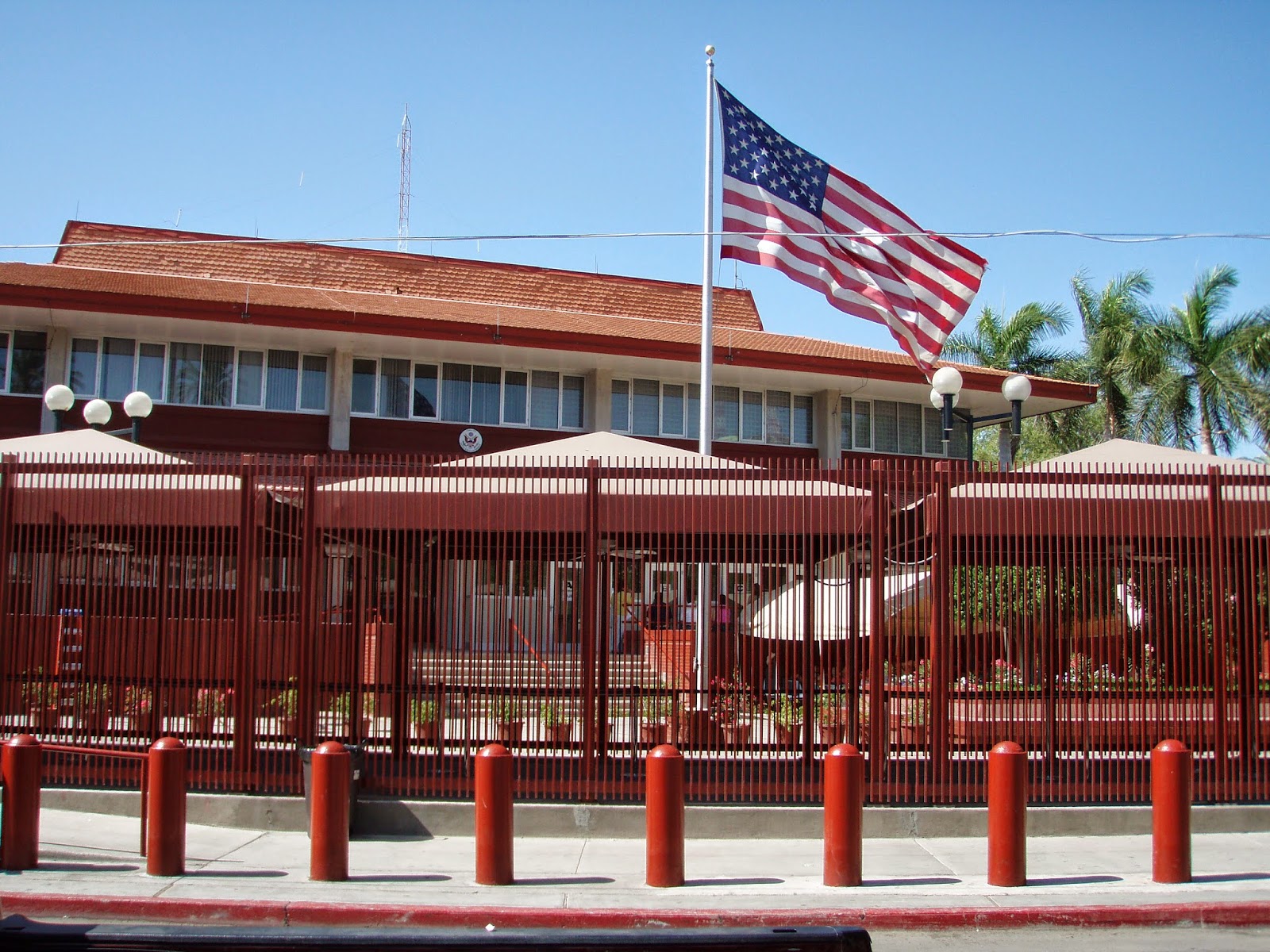
Stop blowing up our drug boats or the fortress embassy gets it. https://t.co/8JufdGZ3iN
— TSB (@TweetingTSB) October 7, 2025
Wednesday, October 8, 2025
A Hollow Threat Against an Empty Embassy
Friday, July 4, 2025
FBI HQ Relocation: Maryland Edges Out Virginia to Play the Security Card
“I think there are enough Republicans who don’t want to put the safety of the men and women of the FBI at risk,” [Maryland Senator Chris] Van Hollen said. “The reason that the three prior sites were under consideration was because they all met the security and setback requirements to ensure the safety of the men and women at the FBI. It was determined years ago that in order to ensure their safety now into the future, you needed a campus like the CIA has at Langley, like the NSA has out at Fort Meade.”See the WTOP news story here, Maryland delegation vows to fight FBI’s move to new DC location ‘with every tool we have’
Thursday, July 3, 2025
New FBI HQ: Good Building, Bad Idea
That building cannot met some key security standards that apply to an FBI HQ. Either this idea is a nonstarter or someone will have to approve a waiver. https://t.co/xyS869sl6y
— TSB (@TweetingTSB) July 2, 2025
Saturday, April 27, 2024
Embassy In a What?
You can’t get an embassy in a box unless you push *real hard.* https://t.co/m7RIcMsYyV
— TSB (@TweetingTSB) April 26, 2024
Requires the State Department to develop an “embassy in a box concept” that provides expedited procedures and physical resources needed to stand up new diplomatic missions overseas.
Requires the secretary of State to issue guidance so the Department can build new embassies more quickly and save taxpayer dollars.
Wednesday, April 10, 2024
Video Released From Ecuador's Forced Entry Into Embassy of Mexico
Thursday, March 24, 2022
Back to the Future With Legations and Diplomatic Agents - Yes!
Would a legation offer an alternative in future situations — North Korea, Taliban Afghanistan come to mind — where the U.S. would want to establish more than an “interests section” housed within a foreign embassy, but less than full embassy status with an ambassador?Now, that (this, in the current Foreign Service Journal) is an exceptionally good idea.
Saturday, November 27, 2021
New Embassy Compound Beirut - Why Will it Take a Decade and a Billion $$$ ?
New photos of the construction process of the massive US embassy in Lebanon. It is expected to be finished in 2023.
— Lebanese News and Updates (@LebUpdate) November 25, 2021
The embassy would be one of the biggest in the world, built on 43-acres.
Photos by: @ftn001 pic.twitter.com/mKqB3TuywV
Part of me is thrilled to no end that U.S. Embassy Beirut will, sooner or later, move out of its dinky and haphazard present facilities in East Beirut and into a big, purpose-built, New Embassy Complex. That is an occasion we've been waiting for ever since the previous embassy was destroyed by a suicide truck bomb in 1983, and then the East Beirut embassy annex itself was partially destroyed by a second suicide bomber in 1984.
1983? 1984? What a long time ago. How many current State Department employees had not yet been born in those years? That replacement embassy has been a long time coming.
Not to spoil my good mood, but what explains the insanely long time between the start of the project and its projected completion date?
Friday, June 25, 2021
Fortress Embassy Niamey Has a Weird Facade
Thursday, May 6, 2021
New Consulate Office Building in Hermosillo, Mexico, Topped Out
Consul General Ken Roy held a topping out ceremony today to celebrate the structural completion of the new @USConsuladoHer @BLHarbert @PageThink #consulate #construction #architecture #design #diplomacy #sustainability #Hermosillo #Mexico #StateOBO pic.twitter.com/V3WpTQzPlC
— Bureau of Overseas Buildings Operations (@State_OBO) May 4, 2021
Saturday, April 10, 2021
Fortress Embassies to be Fully Funded in the New FY
![]() |
| (CG Guadalajara, according to an OBO design contractor) |
EMBASSY SECURITY, CONSTRUCTION, AND MAINTENANCE - The Bureau of Overseas Buildings Operations (OBO), funded through the Embassy Security, Construction, and Maintenance (ESCM) appropriation, is responsible for providing U.S. diplomatic and consular missions overseas with secure, safe, and functional facilities that represent the U.S. Government to the host nation and support the Department’s staff in their work to achieve U.S. foreign policy objectives. These facilities represent the best of American planning, design, engineering, construction, and facility management.
The FY 2021 Request is $1.7 billion. The work supported by this request is vital, as more than 93,000 U.S. Government employees from more than 30 agencies at over 291 locations depend on the infrastructure OBO provides and maintains. The FY 2021 Request includes the Department of State’s share of the $2.2 billion Capital Security and Maintenance Cost Sharing Programs to construct and maintain, new, secure facilities, and $100 million to address deferred maintenance for State’s non-cost shared facilitiesWhich lucky posts will get the next round of safe, secure, and functional new facilities? That is a carefully risk-managed decision, as is explained in this publicly available source of information:
OBO will continue to construct diplomatic facilities based on the Department's list of the most vulnerable facilities and to address other security concerns overseas consistent with available resources. This Vulnerability List, published each year by DS, ranks posts according to their vulnerability across different security threats. The process for identifying and prioritizing projects begins with a review of the Vulnerability List mandated by SECCA. The Vulnerability List is then used to establish the Top 80 list that helps OBO to prioritize facilities that need to reduce security vulnerability. In addition to new construction projects, OBO must also design and construct security upgrades to existing facilities.That sounds like a tricky business, but I assume whoever it is in DS who ranks overseas posts according to their vulnerability to security threats must know what he or she is doing.
Saturday, February 27, 2021
The RAND Corp Reports on Durations of Attacks on Western Diplomatic Facilities
What were the durations of attacks on Western diplomatic facilities since 1979, and how much advance warning was there of each attack? And,
What implications do historical timelines of duration and advance warning of attacks on diplomatic facilities have for efforts to respond to such attacks?
Sunday, April 5, 2020
Who Will Pay For This Screw-Up in Ashgabat? The 90 to 125 Million Dollar Question
![]() |
| Ashgabat, Turkmenistan, city of white marble and straight lines |
This might be the most consequential screw-up in U.S. embassy construction since the Moscow debacle of the 1980s and 1990s. (For a summary of that long-drawn-out disaster, which nearly resulted in embassy construction responsibility being taken out of the hands of the State Department, see the embassy's website.) Anyway, that's the only other one I can recall in which we had to demolish a newly-built embassy.
If it weren’t for the COVID-19 emergency taking up all of Official Washington’s time and attention, we would surely see State getting thrashed by Congress and the White House over an OIG audit report for Ashgabat, Turkmenistan, that came out in February. No one seems to have noticed it yet, which is understandable given the pandemic health crisis. However, the report makes clear that there will be a follow-up, and quite possibly a formal notification to Congress of waste and mismanagement, so I don't see any way that my good friends in OBO will escape repercussions forever.
You can read all about it in Review of Delays Encountered Constructing the New Embassy Compound in Ashgabat, Turkmenistan, a pedestrian title which gives no hint of the political dynamite inside the report.
The report is unclassified and uncontrolled, put out there on the internet for all the public and Congress to see. The OIG certainly isn't hiding it. They even put it in their Twitter feed on February 27. Hey, congressional oversight committees, you're missing a good one here.
The gist of the matter is that since 2016 OBO has been building a new U.S. embassy in Ashgabat, which is a city that imposes two absolute requirements on new buildings: they must have facades of white marble and they must be set back from the street a precise distance, which is referred to as "the red line." Well, we built the main embassy office in the wrong place. And now we will have to demolish it and build it again, this time in the place where the local authorities told us all along it had to go.
From the OIG Report:
[I]n July 2016, the Government of Turkmenistan halted construction of the NOB [New Office Building] because it was being constructed in a location that violated the city’s red line. This error occurred, in part, because OBO personnel failed to follow internal procedures that guide the planning of construction projects … Moreover, they did not require the Architectural and Engineering firm that prepared the project bridging design to deliver required planning documentation that would have alerted OBO about the proper placement of the NOB. In addition, the construction contractor, Caddell, failed to obtain required construction permits from the Turkmen Government prior to initiating construction. As a result, construction of the NOB was halted after approximately $26 million had been expended to construct the facility.
-- Snip --
The operational and financial implications from the improper placement of the NOB are profound. Specifically, because construction of the NOB has not been completed, embassy operations continue to be conducted from multiple locations. According to OBO’s FY 2014 Congressional Notification for constructing the NEC, this arrangement creates security and safety risks. In addition, OBO estimates that it will cost the Department between $90 million and $125 million to rebuild a new NOB in an approved location. This amount is approximately twice what was originally budgeted to construct the NOB.
So many fingers of blame to point at so many parties! And did they say we're going to pay twice the cost that was originally budgeted in order to get this project completed? Yes, well, that will happen when first you construct a building, then you have to tear it down and construct it a second time.
Keeping track, that’s $26 million in sunk costs – construction, design, contractor mobilization, project supervision – to build the wrongly-sited and unpermitted chancery office building, plus between 90 and 125 million in future costs to re-build the chancery on the correct side of the host government’s red line.
For some background on that red line, see The City of White Marble to appreciate how very, very, particular the host country’s government and its President - Protector of the Turkmen! - are about their architecturally eccentric capital city.
Ashgabat may be the strangest city anywhere outside of North Korea. Still, all they asked of us was a white marble chancery building that respected their setback distance from the street so as to keep our new embassy in geometric harmony with every other building in the neighborhood. That’s not so much to ask.
The dramatis personae in this story of – likely – waste and mismanagement include:
- OBO’s first project manager, now retired, who failed to ensure that the local legal assessment report was properly filed away with OBO headquarters
- The architectural firm OBO used to prepare the planning documents that guided the eventual design and construction, which failed to press with OBO the issue of the missing local legal assessment
- The Office of Acquisitions Management and the Office of the Legal Advisor, who must now determine whether a screw-up by the first project manager relieved OBO's construction contractor from its contractual obligations, or whether that contractor is liable for damages
- The construction contractor, Caddell, who failed to obtain a local building permit, or to verify that one had been obtained, before plunking that new chancery down right on top of the local red line; Caddell is now on the hot seat for paying big damages to OBO, or, just maybe, to boldly charge OBO even more money to compensate for the four years it has been required to suspend work on the chancery ('equitable adjustment for the cost and time impacts'), which I bet would be quite the bargaining chip in a possible settlement negotiation
- The U.S. Congress, who will eventually wake up to this news, if not now, then in a few more months when they may well get official notice from the OIG that it has found a case of waste and mismanagement
There are also lesser players, like the OBO Director and his headquarters staff, and the Under Secretary for Management. I foresee a judge and jury getting involved, as well.
The current U.S. Ambassador and his predecessor come off pretty well, since the OIG makes clear that they both tried to talk sense to Washington while headquarters officials dithered in the four years since Turkmenistan authorities ordered a halt to construction, refusing to bite the bullet and just demolish that offending chancery.
“By January 2019, the U.S. Ambassador to Turkmenistan informed OBO that he saw no realistic chance the Turkmen Government would allow the building to be completed in its current location, and he advised OBO that the only path forward was to demolish the NOB and rebuild it in accordance with the Turkmen Government’s red line requirement. In June 2019, the newly appointed U.S. Ambassador met with the President of Turkmenistan and again attempted to find a solution other than demolishing and rebuilding the NOB. In response, the Turkmen President reiterated that the red line is Turkmen law and must be upheld.”
But instead of accepting that Turkmen reality, OBO tried to wriggle off the hook. It proposed adding a massive fig leaf – an earthen berm – to make the chancery’s red line intrusion harder for passersby to see, but the local authorities didn’t go for that. It explored a partial demolition of the unfinished chancery, but that was not a viable option. It even asked the locals if they would be open to a cost-sharing arrangement to pay for the full demolition and reconstruction of the chancery, but no such luck.
To me, that dithering and wishful thinking is the greatest fault in this sad story. It should not have taken four years to face the facts and understand there is no way out of this dilemma other than knocking down that partially-finished chancery. The sooner you do it, the faster this will be over and the fewest dollars will have been wasted.
Now, having dragged the problem out for four years, not only does OBO still have to rebuild the chancery, but State has a major legal problem and financial exposure on its hands if it tries to fix responsibility on its construction contractor, Caddell. After all, it was Caddell that failed to obtain a construction permit for the new embassy, which is a huge oversight, to say the least. So doesn't Caddell own this 90 to 125 million dollar problem? Maybe. But what equitable adjustment does OBO owe Caddell for the four years since it ordered Caddell to stop work on the biggest part of its Ashgabat contract? The answers will depend on how a judge sees contractual orders of precedence and other matters of procurement law.
Finally, let’s not forget the staff of the U.S. Mission in Turkmenistan, who will continue to have their operations split between multiple locations, some of them highly deficient in both security and safety (in particular, seismic safety) for years to come.
More to come on this, for sure.
Saturday, November 3, 2018
Picking Up the Pace of New Embassy Construction
The U.S. Government Accountability Office recently published a report criticizing my good friends in the Bureau of Overseas Buildings Operations for failing to maintain the rapid pace they had previously set in the Capital Security Construction Program, that long-term program for replacing our most vulnerable overseas diplomatic facilities with 'safe, secure, and modern' new buildings.
You can read the GAO report at a publicly available source of information here: Embassy Construction: Pace Is Slower Than Projected, and State Could Make Program Improvements. A couple excerpts will provide the background for that long-term new embassy building program:
Following the bombings in Africa, the Secure Embassy Construction and Counterterrorism Act of 1999 required State to develop and report a list of diplomatic facilities scheduled for replacement based on their vulnerability to terrorist attack. One of the congressional findings in the Secure Embassy Construction and Counterterrorism Act of 1999 was that unless embassy vulnerabilities are addressed in a sustained and financially realistic manner, the lives and safety of U.S. employees in diplomatic facilities will continue to be at risk from further terrorist attacks. State subsequently initiated the CSCP [Capital Security Construction Program] to construct new embassies. The CSCP is administered by OBO. [Page 10]
In general, according to OBO policy, the CSCP is guided by Diplomatic Security’s annual Security Environment Threat List of security rankings for posts, from which OBO develops a “Top 80” list of the 80 most at-risk posts needing a new embassy. OBO uses the Top 80 list to develop and adjust the CSCP schedule, which presents planned embassy awards for the current fiscal year and for each of the next 5 fiscal years. [Page 26]
Well, I'm not sure I share the GAO's concern about the slowing pace of new construction starts, because this past week - which, as you government-employed people, know is the start of a new Fiscal Year - OBO signed a bundle of new design or construction contracts. Here are the press releases:
The Department of State announces the selection of Skidmore, Owings, and Merrill of San Francisco, California as the design architect for the new U.S. Embassy complex in Windhoek, Namibia ... The multi-building complex will be situated on a site in the Klein Windhoek neighborhood and will provide a safe, secure, and modern facility platform for the Embassy community and those it serves.
The Department of State has awarded the construction contract for the new U.S. Embassy in New Delhi, India to B.L. Harbert International of Birmingham, Alabama ... This complex will provide a safe, secure, and modern facility platform for the Embassy community and those it serves. Weiss/Manfredi Architects of New York, New York is the architect for the project.
The Department of State has awarded the construction contract for the new U.S. Embassy in Tegucigalpa, Honduras to B.L. Harbert International of Birmingham, Alabama ... This complex will provide a safe, secure, and modern facility platform for the Embassy community and those it serves. SHoP Architects of New York, New York is the architect for the project.
The Department of State announces the selection of Miller Hull Partnership of Seattle, Washington as the design architect for the new U.S. Consulate General project in Merida, Mexico ... The multi-building complex will be situated on an approximately seven acre site in the Via Montejo development and will provide a safe, secure, and modern facility platform for the Consulate community and those it serves.
The Department of State has awarded the construction contract for the new U.S. Consulate General project in Guadalajara, Mexico to B.L. Harbert International of Birmingham, Alabama ... This complex will provide a safe, secure, and modern facility platform for the Consulate community and those it serves. Miller Hull Partnership, LLP of Seattle, Washington is the design architect for the project and Page of Washington, D.C. is the architect of record.
The Department of State has awarded the construction contract for the new U.S. Consulate General project in Hermosillo, Mexico to B.L. Harbert International of Birmingham, Alabama ... This complex will provide a safe, secure, and modern facility platform for the Consulate community and those it serves. Richard + Bauer of Phoenix, Arizona is the design architect for the project and Page of Washington, D.C. is the architect of record.
That's six new embassies and consulates now under contract, which is not too shabby. Also, it creates six new slots on that Top 80 list of most at-risk posts for consideration in next year's prioritized contract awards. And for the year after that, and so on, for as long as Congress keeps the Capital Security Construction Program money coming.
Saturday, October 14, 2017
Dusting Off the Bauhaus Fortress, and Other New Construction Awards This Week
![]() |
| Photo of U.S. Embassy Athens from Discover Diplomacy |
My good friends in Overseas Buildings Operations have had a hot hand this past week, signing contracts for the construction of a new U.S. Embassy in Guatemala City, Guatemala, and for the construction of a new U.S. Embassy Annex in Kampala, Uganda, and for the major rehabilitation of the U.S. Embassy in Athens, Greece.
The Athens project is by far the most complex and architecturally interesting of the three awards. The project "includes the rehabilitation of, and additions to, the existing chancery and other buildings. The architect for the project is Ann Beha Architects of Boston, Massachusetts." That design firm, as we learned from Architect Magazine, specializes in "dusting off forgotten buildings and marshalling them into the present day" and the firm's proposal to OBO "conveyed a sophisticated understanding of the issues involved in renovating historically significant buildings and experience with rehabilitation of complex mid-century modern structures."
Our chancery building in Athens could use a good dusting off. OBO describes it as follows:
The Athens Chancery, by architect Walter Gropius, one of the most celebrated representatives of the famed Bauhaus School, is a modern tribute to ancient Greek architecture. The architect designed the building as a metaphor for democracy in the country to which modern democracy owes so much.
Completed on July 4, 1961, the three-story edifice is markedly open. The landscaped courtyard provides a place for discussion and meeting. The white columns and brilliant reflective surfaces of the exterior façade are clad with Pentelic marble, the famous stone used in the Parthenon, other buildings on the Acropolis, and throughout the ancient Mediterranean. Black marble from Saint Peter, Peloponnesus, gray marble from Marathon, and other native Greek marbles are used throughout the building. The beautifully-turned wood stair railing was made with Greek pearwood by Greek artisans.
Contemporary architecture magazines described the chancery as “a symbol of democracy at the fountainhead of many old democratic and architectural traditions” by “one of modern architecture’s Olympian figures,” Walter Gropius, and his associates at The Architects Collaborative (TAC). Gropius said that he sought “to find the spirit of [the] Greek approach without imitating any classical means.” The podium, quadrilateral plan, interior patio, exterior columns, and formal landscaping were all handled in a thoroughly modern way.
The building’s climatic response includes ceramic sunscreens, wide overhangs, free flowing air at continuously slotted over hangs, and a bipartite roof. Upper floors hang from the roof structure. Gropius placed a reflecting pool at the main entrance and fountains in the landscape to create serene settings and cooling from the Greek sun. The floor plan is arranged in a sweeping crescent that embraces a large formal terrace descending to a lawn and garden.
The Athens Chancery remains a fresh and optimistic bow to the classical ideal and one of the most prominent Bauhaus buildings in Greece.
So basically, the chancery is supposed to look like the Parthenon - see the resemblance? - only with a Modernist flat roof and glassed-in sides. It doesn't seem like promising material for a Fortress Embassy of the modern type. But, I have all the confidence in the world that my good friends can pull this off.
Wednesday, June 14, 2017
Wine and Cheese Designs on a Coffee and Doughnuts Budget
![]() |
| New York Times photo |
Wine and cheese? My good friends in the Bureau of Overseas Buildings Operations would love to go to charettes like that again! But, these days, I doubt the contractors dish out anything so good.
What put me in mind of wine and cheese was listening to the morning session of today's House Foreign Affairs Committee budget hearing, in which Representative Darrell Issa, questioning SecState Tillerson, spoke up for the plain but functional standard embassy designs that OBO built in the past, and denounced the "New York wine & cheese liberals” advocating works of art whom he believes took over our embassy design planning during SecState Hillary Clinton's tenure.
Like that "glass palace" in London (see this) that costs too much and which we haven't even finished yet, for example. Let's go back to the "efficient design and build" practices of the past, Issa said.
Tillerson really didn't speak to the design issue, but he did assure Issa that the Administration's 2018 budget plan will maintain OBO's current new construction program for another year, although we'll run into "planning difficulties” in 2019.
Wednesday, May 24, 2017
2018 Budget Request Released; OBO Walks Away Unharmed
The 2018 State Department's 2018 budget justification was released yesterday, and with it a press conference was conducted. There you go, news media! Don't say Silent Rex doesn't ever think about you.
Here's how the request impacts my good friends in the Office of Overseas Buildings Operations.
The 2018 budget request basically cuts the funding for Embassy Security, Construction, and Maintenance, and the much smaller Compound Security Upgrade program, in half. The ESCM request is for $1,142,200, which is $1,731,156 less than last year. Nevertheless, it provides sufficient funding for seven new capital construction projects in some of the dodgiest places on earth. You can see the project list on page 162.
The Compound Security Program goes down to $50,000,000, which is $50.8 million less than last year. That program "funds comprehensive security upgrade projects, major forced entry/ballistic resistant (FE/BR) door and window replacement projects, chemical/biological retrofit projects, and security upgrades for soft targets," it says on page 163.
Here's the Q and A on security funding from the press conference.
QUESTION: Hey. Thanks for doing this. Two quick questions. Senator Lindsey Graham, who is in charge of the appropriations for State, said, quote, “You have a lot of Benghazis in the making if this thing becomes law.” Can you sort of clarify what the funding will be like for Diplomatic Security around the world, for embassy security, and respond to that charge?
MR PITKIN: Sure. This is Doug Pitkin. I’ll start with the security question ... The administration has appreciated the strong Congressional support for the department security programs over the past several years. They also note with appreciation that they fully funded – in addition to the supplemental, they fully funded the previous standing requests for both our embassy security programs and Diplomatic Security for FY17.
However, in looking at FY18, I think we have to recognize that there are significant funds in the pipeline, partly because of the supplemental that was provided in December. Also, for example, OBO, the Office of Overseas Building Operations, has some 53 projects in the planning process and under construction. And so what we’re proposing in FY18 is – essentially is to use some of our current-year money to buy down or apply towards our construction program in FY18. This shows up as a cut or a reduction in the strict budget line as we’ve presented it, but we will still be able to support $2.2 billion in FY18 embassy construction and security upgrades for those posts in the greatest need of such upgrades. And so this, essentially, reflects the fact that we’re taking a slight reduction in capital investments because we have a lot of funding that we – has been previously appropriated.
So that looks like the 2018 request, plus the "significant funds in the pipeline" from current year funding and supplemental appropriations, will equal last year's funding level for new construction and security upgrades. If that budget makes it through Congress, OBO will get away unscathed, at least for next year.
Saturday, January 14, 2017
The End of the Tracks For OBO's Casey Jones
And you know that notion just crossed my mind
-- The Grateful Dead
As the days tick down to January 20, my good friends in the Bureau of Overseas Buildings Operations become a little bit scarcer. Of course, Director Lydia Muniz will depart. So will Deputy Director Casey Jones, who came over from the General Services Administration a few years ago to start OBO's Design Excellence program.
Jones was initially detailed to OBO from GSA, and was later appointed a Deputy Director. I've always assumed he was a political appointee, but was never certain about that. Whatever his employment status, Jones will now resign "to pursue opportunities in the private sector," as was announced yesterday in Architect Magazine.
“We had set a goal of restructuring the way in which our embassies were designed so that they better reflect the best of America and we had some great progress in that area,” Jones says. “We’ve really elevated the quality of our embassies while keeping them on the same schedule and budget, and we have a great management team in place, so I sort of fulfilled my mission.”
What? He said his Excellence program elevated the quality of new embassy construction projects while keeping them on the same schedule and budget? The House Oversight and Government Reform Committee disagrees about that, rather vehemently. But, the criticism of Congress will cease to bother Jones after the 20th of January.
Although Architect Magazine identified Jones as merely the Director of Design Excellence at OBO, according to his official bio, Jones was responsible for much more than that: "Casey Jones is Deputy Director of the Bureau of Overseas Building Operations (OBO) at the U. S. Department of State where he oversees the Program Development, Coordination and Support and Construction, Facilities and Security Management Directorates." That portfolio sounds kind of sweeping, starting with design development and ending with construction management, with security in between.
To an outside observer such as myself it seems that Jones took on a range and level of responsibilities for which his background as, basically, a design consultant, left him ill-equipped. That kind of guy always bugs me. You know, the kind who knows all about how to do a job that he has never actually done himself? If Jones was ever the architect of record or project manager of anything at all, I'll happily stand corrected.
I wish Jones all the best in those private sector pursuits. Meanwhile, for the friends he leaves behind in OBO, there will be trouble ahead as they drive on into the next era of new embassy program management, one in which we Make Embassies Great Again.
Friday, December 23, 2016
Rise of the Bollards
![]() |
| Bollards as 'street furniture' in Washington DC |
How can I send the Trump transition team at State a suggestion? Because I’d like to nominate the UK's Ruth Reed to be the next Director of Overseas Buildings Operations.
I learned of Ms. Reed in a recent UK Guardian article asking what can be done to prevent Berlin-style attacks in modern cities? For my money, she has exactly the right approach to the city planner's problem of securing public spaces against Berlin-style truck attacks.
The Berlin lorry attack on Monday that killed 12 people and injured 48 others raises a pressing question for security services across the world: what can be done to stop such attacks?
The attack on Berlin’s Christmas market came six months after a 19-tonne cargo truck was deliberately driven into crowds celebrating Bastille Day in Nice, killing 86 people and injuring 484.
This seemingly new – and brutally destructive – form of terrorist attack is quickly becoming one that security experts fear the most: it can cause untold carnage and seemingly come out of nowhere. And there are obvious limits on the effect of practical measures.
-- snip --
Ruth Reed, the head of the Royal Institute of British Architects’ (RIBA) planning group and its former president, said counter-terrorism officers [in the UK] would reassess the security of open spaces in the wake of the Berlin attack.
“There will be a degree of reassessment of public open space inevitably after Berlin. I think that will happen all over Europe, not just here,” she said. “The British approach has always been to put in a degree of protection. They may want to think about increasing it – but it can be done discreetly.”
Reed co-authored industry-leading guidance (here), published in 2010, on designing for counter-terrorism without turning the nation into an uninviting fortress.
The most obvious form of protection against a truck attack are large barriers, known in the architecture business as “anti-ramming landscape features”. The black barriers around the Palace of Westminster are designed to stop a lorry attack at high speed. Up the road in Whitehall, there are barriers but they are hidden from view.
All US military and governmental buildings have “crash- and attack-resistant bollards” outside. The US state department “anti-ram vehicle list” lists several types of bollards to protect the perimeter of its embassies abroad. Some bollards are capable of stopping vehicles travelling at up to 50mph (80km/h).
“It’s not just the point of obstruction,” said Reed, who pointed out that measures including tight bends and restricted-width streets had been designed to prevent a large vehicle building speed before reaching a bollard or barrier ... “The important thing for public sanity really is that we don’t let this kind of anti-terrorism provision cloud our thinking because, if we develop some kind of bunker mentality, we’ve actually let them win,” she said.
“We want people to be able to go about their normal working and leisure times blissfully unaware that there is a risk that has been considered and reduced or eliminated. That’s the really important thing to say."
Now, it's not for nothing that Washington DC is known as The City of Bollards, so we do know a thing or two about using them discreetly. Check this out, for instance.
Bollards come in all kinds of shapes and sizes. There are low ones and high ones, fixed in place and operable ones, free-standing and tied together, ugly and decorative, old timey and modernistic. They can be made of steel, concrete, or polycarbonate. They can be intrusive or subtle, round or cylindrical, straight or curved, architecturally enhancing or utilitarian, blended into the background or black-and-yellow striped. They can even be repurposed old cannons half-buried in the ground, a common practice in the 17th and 18th Centuries, examples of which can still be seen today in most old port cities.
If you spend any time in a city, you can see bollards all around you as you go about your daily life. Pay some attention to them, because they are on the rise, and they can save lives.
Thursday, December 8, 2016
House Oversight Cmte Scopes Out Embassy Construction Cost Overruns
![]() |
| What is up with this misguided love of night vision gear? |
Consumer Notice: This post is certified 100% free of Matters of Official Concern that are not referenced from publicly available sources of information.
I get it that House Oversight Committee Chairman Representative Jason Chaffetz won't have Overseas Buildings Operations Director Lydia Muniz to kick around much longer, what with her being a political appointee and therefore departing her position by January 20. But the majority staff report he released this week is "littered with unsubstantiated allegations, cherry-picked evidence, and conclusions that contradict the overwhelming evidence that we obtained," in the words of the Ranking Member from the minority side of his committee. Really, what was the big hurry that this report couldn't have waited for a review by the minority side and a vote by the whole committee?
The State Department's Assistant Secretary for Legislative Affairs asked the Committee to submit the report for an interagency classification and sensitivity review before releasing it to the public, since it "details security methods and vulnerabilities at specific embassy construction sites, provides information that could be used to identify and target classified areas and communications, describes methods used to secure classified areas, and provides information about the Department's foreign intelligence countermeasures." But did they? No.
Here's that letter from State to Chairman Chaffetz, courtesy of CBS News.
UPDATE on December 29: I see that the HOGR Committee has now, properly and responsibly, withdrawn its staff report from the public sphere. Accordingly, I've deleted the remainder of this post. In the event the Committee re-releases the report, I'll comment again at that time.
Saturday, October 8, 2016
That's Fortress Embassy Number 133
![]() |
| Image from U.S. Embassy Paramaribo's flicker page |
My good friends in the Bureau of Overseas Buildings Operations have opened another new U.S. embassy, this one in Paramaribo. It was designed by ZGF Architects and built by general construction contractor BL Harbert International, has 5,348 gross square meters of space, and cost $164 million.
From the press release, United States Dedicates New U.S. Embassy in Paramaribo, Suriname:
As a symbol of our enduring relationship with Suriname, Under Secretary for Management Patrick F. Kennedy, U.S. Ambassador Edwin R. Nolan, and the Bureau of Overseas Buildings Operations (OBO) Principal Deputy Director William Moser, alongside local officials, dedicated the new U.S. Embassy in Paramaribo on October 5.
The multi-building complex, on an 8-acre site in the Morgenstond development, includes a chancery, support buildings, and facilities for the Embassy community. The new complex will provide embassy employees with a safe, secure, and sustainable workplace.
-- snip --
Since 1999, as part of the Department’s Capital Security Construction Program, OBO has completed 133 new diplomatic facilities and has an additional 53 projects in design or under construction.
Did I read that last part correctly? OBO has 53 more projects currently in design or under construction? Maybe they mean under planning, design, or construction. But no matter. By placing 133 U.S. diplomatic missions in "safe, secure, and sustainable" new office buildings, and to have even low double digits more in some phase of replacement, means that OBO has turned a very significant corner. When you include the 22 new embassies that were built in the Inman program era, it means that, for the first time ever, a majority of our missions are now in Fortress Embassies. The norm for U.S. diplomatic facilities is now a Fortress, for better or worse.
How many U.S. diplomatic missions are there? If you use the most expansive list available, there are 294 of them, but that includes missions to international organizations. It's more like 274 if you count just the bilateral missions. Whichever number you use, more than half of them are in Fortresses.
That is a big, big, change from the situation at the time of the East Africa embassies bombings, when nearly all of our missions were highly vulnerable to attack. Those bombings prompted Congress to provide a continuing program of capital funding for new embassy construction. Unlike in the Inman '80s, when the steam ran out of Congress's interest in embassy security after a few years, this time they were as good as their word. So, yea for Congress!
![]() |
| Image from diplomacy.state.gov |
There's the old embassy in Paramaribo, all flimsy ticky-tack and too close to the street. Not safe, secure, or sustainable. Or even especially functional. Good riddance.
Here's a travel tip. The city of Paramaribo is way more enjoyable than I would have guessed. The Dutch colonial influence and a lot of history make up for the miserable climate. Should you visit, be sure to take a trip out of town to see Joden Savanne, a World Heritage site located in the jungle but only a moderate drive outside the city. Starting in the 1630s, Sephardi Jews from the Netherlands, Portugal, and Italy attempted to resettle in part of Dutch Guiana and create a plantation economy along the Suriname River. It was one of the earliest attempts at European settlement in South America, and one of the few by a group fleeing persecution. It was ultimately unsuccessful, but the ruins of Joden Savanne's synagogue and cemetery have been preserved. Highly recommended.